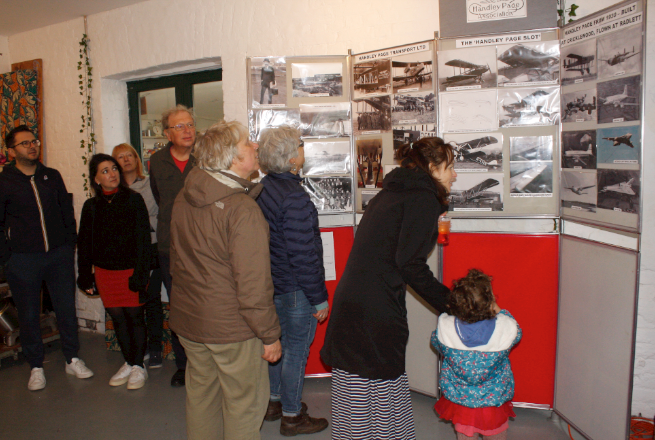
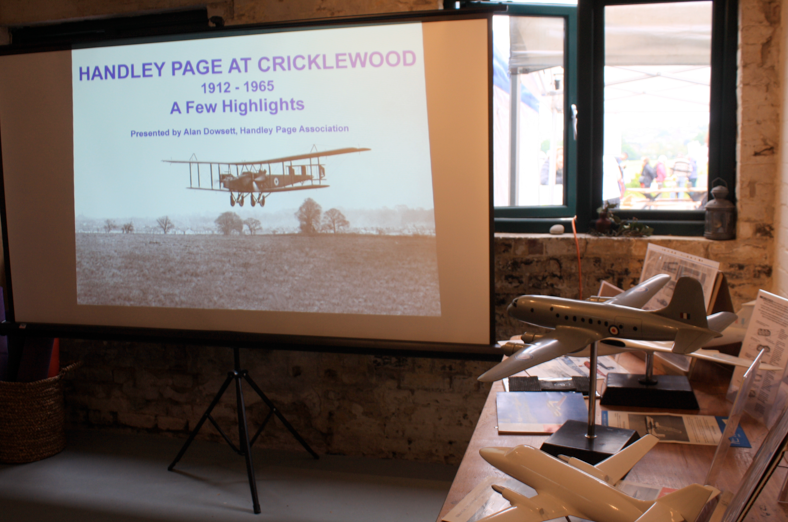
Many thanks to Alan Dowsett and Chris Scivyer from the Handley Page Association and to Gary O’Keefe from the Victor Association for their exhibition and slide show at Clitterhouse Farm on 13 May in support of the Keep Clitterhouse Green campaign – to the tune of The Voice of Reason choir led by Ryan O’Riordan. Clitterhouse Playing Fields is all that remains from Handley Page’s former Cricklewood Aerodrome.
Here are a couple of extracts from the recent Handley Page Association Newsletter.
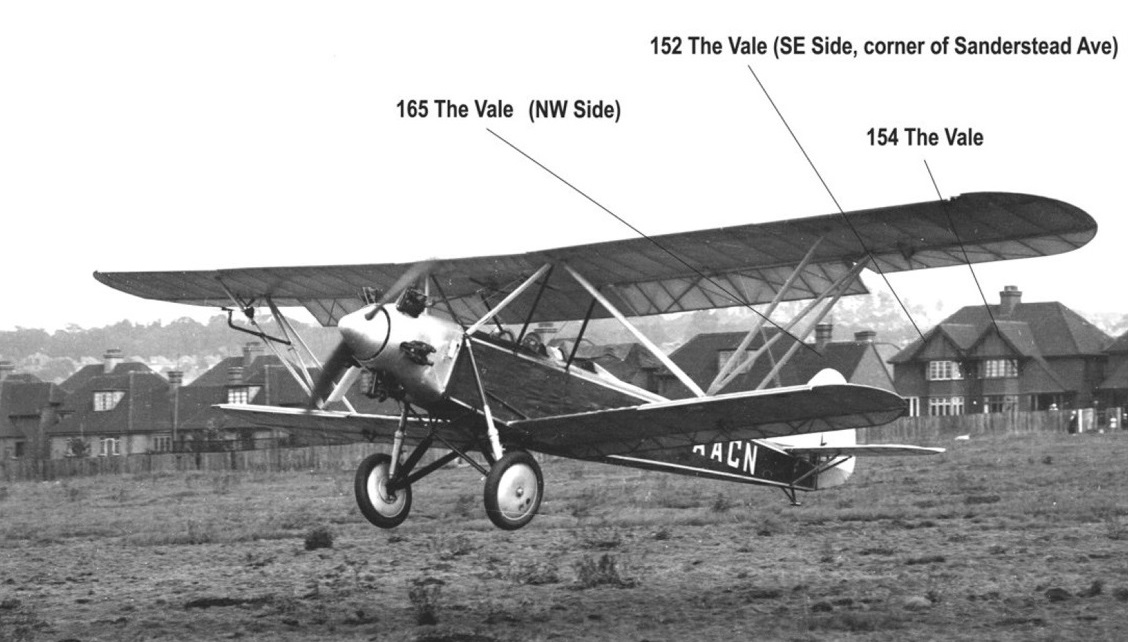
HP39 Gugnunc under test at Cricklewood
This is the HP39 Gugnunc under test at Cricklewood prior to being shipped to Mitchel Field, Long Island, New York to take part in the Guggenheim Safe Aircraft Competition.
Much of Cricklewood aerodrome is now covered by the Golders Green Estate. The houses in the background are in the part-completed ‘The Vale’ and the house numbers have been identified thanks to members of the Golders Green Estate Residents Association.
Royal Aeronautical Society at Cricklewood in 1919
The Royal Aeronautical Society held its very first garden party at Handley Page’s Cricklewood Aerodrome on 29 June 1919. Flight magazine recorded the event in words and pictures:
There was a large gathering at the garden party given by the Royal Aeronautical Society at the Handley Page aerodrome at Cricklewood on Sunday last, and although the boisterous weather did its best to prevent passenger flights, the HP biplanes were more than equal to their task, and took up a large number of passengers, who thoroughly enjoyed their flights in spite of the ‘bumps’. The visitors were received by the chairman and council in the large running-shed facing the aerodrome, and after an inspection of the Handley Page works, in which were seen a number of the machines of the ‘small’ as well as the large type, tea was served in the running-shed.
Here also were on view a Handley Page twin-engined (Rolls- Royce) passenger biplane, recently finished, built to the order of the Chinese Government; one of the fourengined (Rolls-Royce) HPs, a Norman Thompson flying boat with a Beardmore engine, and, by way of contrast, an old Caudron biplane with a 50 hp Gnome engine.
All these machines were inspected by the visitors, and later in the afternoon there was a very interesting lecture, given by Commander T.Y. Baker, RN, and Major L.N.G. Filon, DSc, FRS, RAF, on ‘Navigation on a Transatlantic Flight’.
In another hangar the visitors enjoyed a technical exhibition prepared by the Technical and Research Departments of the Air Ministry, by permission of Brig Gen H.R.M. Brooke- Popham, DSO. This exhibition included instruments of all descriptions, speaking-tubes for use on board aircraft, wireless telephone and wireless telegraph outfits of different types and ranges, aero-cameras of all descriptions with specimens of some of the excellent photographs taken with them, and samples of British and German aero engines. The exhibition was highly instructive, and was greatly appreciated by the visitors. The scientific nature of the exhibits in the hangar was relieved, later in the afternoon, by a very successful and well-attended concert given by the D.A.P. (Department of Aircraft Production) Quartette (Miss Agnes Goddard, Miss G.J. Gowrie, Capt E.J. Webb, and Major A.H. Wood).
It had been intended to give demonstrations of parachute descents, but in view of the high wind which was blowing these were cancelled, and, we think wisely so, since in such a gale it is extremely difficult to judge the right position for jumping with the consequence that the parachutist may easily land on some obstacle and sustain an injury.
In spite of these little variations in the programme, the visitors enjoyed themselves immensely, and all, we think, came away with the feeling of having spent a very interesting afternoon. Besides members of the Society, the guests included representatives of the Air Force and Air Ministry, the Chinese Ambassador, Gen. Squires, the American Air Force Chief, Maj-Gen. Ruck, Maj-Gen. Seely, Maj-Gen. Sir H.M. Trenchard, Maj-Gen. Sir F.H. Sykes, Maj-Gen Sir W.S. Brancker, Sir Robert Hadfield, Mr Handley Page, and Mr Holt Thomas.
Tea was taken in the “running-shed” [hangar] with a background of an O/400 {nearer) and a V/1500
Guests braved the weather to watch the flying or partake of a joy-ride. The hangar then overlooked the airfield, but in later years it overlooked rear gardens in The Vale until it was demolished at the turn of the century.
It is with great sadness that we received the news of David Lang’s passing away on 3rd March. He was a well-respected resident and neighbour.
Former Handley Page apprentice and member of both the Handley Page Association and the Victor Association, he became a devoted Handley Page ambassador, raising awareness among residents, Barnet Council and the Brent Cross Regeneration about the amazing and innovative aeronautical past of this area.
It was thanks to him that we learnt about Handley Page’s innovative airplane designs and the setting up between the World Wars of Handley Page Transport – in particular its pioneering civilian aviation flight from London to Paris, starting from the former Cricklewood Aerodrome, now the Golders Green Estate. Handley Page Transport later merged with other companies to form Imperial Airways, now British Airways.
Golden Jubilee Exhibition to mark the 50th anniversary of the building of the Golders Green Estate on the site of the former Cricklewood Aerodrome. Seen from left to right are David Lang, former Handley Page apprentice and resident of the Golders Green Estate, Kay Pass a former Airwork air hostess and the guest of honour, Wing Commander R H McIntosh DFC AFC RAF (retired), popularly known as All-Weather Mac. All-Weather Mac had a distinguished flying career which began in 1917 and lasted 54 years, flying in both world wars, between the wars and after the second world war. On this historic occasion, David Lang had arranged for All-Weather Mac to return to the site of Cricklewood Aerodrome 60 years after he flew the last international scheduled air service from Cricklewood Aerodrome to Paris, Le Bourget on 28th May 1921 in the Handley Page biplane airliner with the registration G-EATM. He flew this aircraft back to Croydon Aerodrome the following day.
David influenced and was always supportive of the Clitterhouse Farm Project, now Our Yard at Clitterhouse, and the Memories Local History Group.
Cricklewood Station now has a colourful mural honouring the area’s rich aviation heritage
Alistair Lambert artist with Alan Dowsett, Handley Page apprentice and Handley Page Association editor, at the unveiling.
David Lang, resident, and also a Handley Page apprentice and Handley Page Association member could not attend due to health reasons. We owe much to him for keeping the aeronautical heritage of Cricklewood alive and we are delighted that this mural makes it evident.
Clitterhouse Farm and the Memories Local History Group hosted a special history event to celebrate HandleyPage‘s connection to Cricklewood at Whitefield School on Friday, 18 March.
HandleyPagewas an innovative aircraft design and manufacturing company based in Cricklewood between 1912 and the early 1960s. It is also associated with the the start of civil aviation between 1919 and 1929 at Cricklewood Aerodrome, which is now the Golders Green Estate.
Mary Bennett, Golders Green Estate resident with childhood memories of Cricklewood Aerodrome. You can see Mary Bennett talk about the Brent Cross Cricklewood regeneration and our local history in the Whitefield BBC School Report 2016 (Minute 9.25-16.25).
Thomas Ball, from Clitterhouse Farm Project, presenting Peter Hart and Rob Langham with Cricklewood’s own brewed beer.
Peter Elliot’s presentation on the Handley Page Collection held at the RAF Museum.
Our own Mary Bennett’s memories gave the night the human touch.