Author Archives: Mike de Jong

Archaeological Investigations

Judy Lester kindly passed on the following about the MOLA dig in Clitterhouse Playing Fields in 2021/2022.

Our archaeologists unearthed centuries of history, resting just a few feet beneath the ground.

Roman Farmers

Our dig has revealed that during the Roman period (AD 43-410), the area was already being used for farming. We found several ditches, which separated different fields. Surviving fragments of Roman pots, bricks and tiles have helped us date these ancient boundaries. One of these ditches was part of a curved or circular enclosure and here we recovered a cow’s tooth, evidence for the presence of domesticated animals.

We also retrieved some plant and insect remains from the fill of the ditches, and they helped us reconstruct what the landscape looked like in Roman times. We identified buttercups and water fleas, usually found by ditches and ponds that would seasonally dry out.

Archaeology and Old Maps

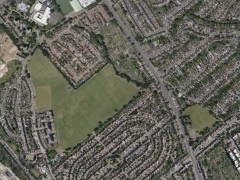
People continued to grow crops and raise livestock for centuries at Brent Cross. Although now a part of London, historic maps have shown this area remained rural until quite recently. The current shape of Clitterhouse Playing Fields can be traced on maps of over 160 years ago, split over several fields which were later combined to form the park.

Before we started digging, the field was investigated by a geophysical survey. Geophysical surveys use a variety of tools to sense for walls, ponds or ditches that might be beneath the ground. These instruments register changes in magnetic strength and electrical conductivity or may use a radar to produce an image of what’s under our feet. They can help archaeologists understand where they should excavate.

One of the things registered by the geophysical survey carried out at Clitterhouse Playing Fields was a large magnetic anomaly. By checking the 1754 plan of the ancient manor of Hendon we found out this corresponded with the location of an old pond, later backfilled and now disappeared. The pond was investigated as part of the MOLA dig and it produced some of the best-preserved finds from the site.

Whilst railways have served the area since 1870 (when Cricklewood Station opened), this part of London maintained its rural character well into the 1920s. During World War II part of the park was turned into allotments and we found the remains of some of the concrete air raid shelters built at the time.

Snapshots from the Past

We unearthed many different objects at Clitterhouse Playing Fields, some very old, others revealing peculiar stories from the near past.

One of the most interesting finds is dated to the Roman period. In one of our trenches we found a small fragment of a beaker produced in Cologne. Almost all Roman materials found on site were made fairly locally, however this pot shows how goods travelled all around the Roman empire, even reaching rural areas of Britain.

Our archaeologists also recovered many glass bottles dating to the Victorian period (1837-1901), most of them from the old pond. The majority were used for soft drinks, but among them was a far more sinister container – a poison bottle. Poison bottles had distinct shapes that changed based on what was inside them. This was so they could be recognised by touch even in the middle of the night, when candles were often the only source of light. It was important for people to correctly identify what they were looking for, to avoid ingesting the wrong liquid! Our blue-glass poison bottle was filled with ‘granular citrate of magnesia’, the name clearly stamped on its side. However, despite the deadly name given to its container, this substance was used to cure constipation. It can still be found on the shelves of health food shops!

Lastly, our archaeologists identified a rather ‘recent’ find – a German bayonet. This specific model was in use before and during WWI. How did this weapon end up in a park? Was it brought to London as a souvenir – or maybe a trophy – by a former English soldier? Or did it belong to a collector who discarded it after the war?

Not every archaeological dig uncovers beautiful mosaics, precious objects, or large buildings, but this doesn’t mean our discoveries are any less relevant in the story that they tell. Our dig at Clitterhouse Playing Field has unearthed the story of a community changing through times, as Roman fields slowly became part of a bustling city. This story now continues with the new regeneration plans. Who knows what future archaeologists will excavate here?

Clitterhouse Playing Fields are being regenerated as part of Brent Cross Town, a partnership between Argent Related and Barnet Council, managed by Galldris. If you are interested in the current plans for the Brent Cross Town development, find out more at https://www.brentcrosstown.co.uk/vision.
B&Q Site: Barnet is Opposing

From the NorthWestTWO website …

The inquiry into Montreaux’s planning application for the B&Q site (1049 residential units, up to 18 storeys) is coming in February 2023. On 8th November, Barnet’s Strategic Planning Committee met to decide how to approach it. Council officers began as if for an appeal and proposed, basically, that as the committee had voted to approve the application last year, the council should support it at the inquiry. Seems obvious, but ….

For NorthWestTWO, Ben argued that it’s an inquiry not an appeal; the council had never issued a decision that it now had to defend; the committee had never approved the officers’ flawed report or voted on the merits of the application; a then-leading councillor had told them it was very bad but they had to vote to approve it, otherwise the Mayor of London would impose something worse. Oh, we also revealed that the draft Local Plan, which supported the development, is in trouble.

For the Railway Terraces, Jessica expanded on that and on just how bad the development would be for the Terraces and all Cricklewood. Councillors Schneiderman and Clarke spoke strongly against it too.

The committee voted 1:6 against the officers proposal, i.e. against supporting the application.

It didn’t end there. Pretty soon the officers had worked out an alternative proposal and that was carried 6:1, with cross-party support. Barnet’s position at the inquiry will be, in part:
The proposed development and the parameters sought, by virtue of the excessive height, scale and massing would result in a discordant and visually obtrusive form of development that would demonstrably fail to respect the local context and its established pattern of development, to the detriment of the character and appearance of the area and the setting of the adjacent Railway Terraces Conservation Area.

We’re very pleased. We still want to join in at the inquiry, there’s even more than that to be said, but it won’t be the residents against Barnet and the developers. The council is now with us.

Kreativ Play

On Thursdays on 23rd February and on the 9th, 16th, 23rd and 30th March Kreativ Play is running ‘Outdoor Adventures’ for 2 different age groups:

10:00 am – 12:00 pm (2–5 year olds) The Woodchips
4:15 – 5:15 pm (6–9 year olds) Super Shoots

The Woodchips

This Outdoor Play group is designed for 2–5 year olds with their grown ups.

Single session cost: £15 (for 1 x Child, 1 x Adult and 1 hot drink from the café for the accompanying adult.)

This programme is designed so you and your little Woodchips have the time to build relationships with new friends and make a deeper connection with the natural world.

Expect games, singing, parachute time, nature craft, a mud kitchen and exploring in a relaxed environment.

Your little ones will develop an enjoyment of being outdoors for longer periods of time in all seasons and weather conditions.

We encourage booking the full programme as the regularity of outdoor time will benefit your child’s enjoyment and development. However, we understand life can get busy, so please join us on any Thursday.

Tickets via Eventbrite: https://www.eventbrite.co.uk/e/the-woodchips-outdoor-adventure-2-5yrs-tickets-531086613357. Booking also available in person via Our Yard café.

The sessions are 1 hour long and fully outdoors with half an hour either side to settle in, socialize and enjoy the community café.

Wear clothes that can get muddy. Waterproofs are always a good idea!

Bring a warm hat and gloves for chilly ears and fingers on colder days!

The Super Shoots

This is an after school group designed for 6–9 year olds and their adults.

Single session cost – £15 (for 1 x Child, 1 x Adult and 1 hot drink from the café for the accompanying adult.)

Schools out, so now let’s go on an outdoor adventure.

This programme is designed so the older Woodchips have the time to build relationships with new friends and make a deeper connection with the natural world.

Expect games, encouraging imagination, nature craft, exploring flora and fauna and much more, in a relaxed environment. The perfect way to wind down after school, being in tune with nature.

Children will develop an enjoyment of being outdoors for longer periods of time in all seasons and weather conditions.

We encourage booking the full programme as the regularity of outdoor time will benefit your child’s enjoyment and development. However, we understand life can get busy, so please join us for any of the dates as drop in sessions as you can.

Each session is 1 hour long and fully outdoors. Book a place at Eventbrite: https://www.eventbrite.co.uk/e/super-shoots-outdoor-adventure-6-9-yrs-tickets-531168889447.

Wear clothes that can get muddy. Waterproofs are always a good idea!

Bring a warm hat and gloves for chilly ears and fingers.

We encourage grown ups to enjoy a cup of tea/coffee on us inside the café, while your children are immersed in all things nature.

Our Yard at Clitterhouse Farm

Anika writes …

The garden is now slowly re-awakening after its winter slumber and the first daffodils and hyacinths are poking their heads out of the ground. Over the last few weeks, the garden team has been busy pruning berries and fruit trees and has made a start sowing broad beans, chillies and sweet peas.

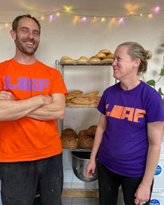
We are very excited to introduce Sean & Meagan and Hannah, our new tenants. Sean and Meagan moved their bakery to the farm and are now selling their freshly baked bread and delicious pastries at the café (which is now open on Thursdays, Fridays and Saturdays, 10:00 am – 5:00 pm) and via their website www.seansloaf.co.uk. Why don’t you pop by and find out more?

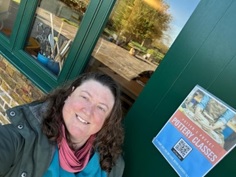
Hannah Milson (#potterspocket22), an inspiring local artist, opened her pottery studio at the Farm last October. Hannah is running regular workshops for children and adults throughout the year.

In addition to our weekly community gardening sessions, lots of other workshops are now in full swing: outdoor adventures with Kreative Play (see more below) and Little Critters; Mindfulness through art sessions creating watercolour floral artworks and bamboo sumi-e paintings; and a Hatha Yoga session. You will find all the information on our website www.ouryard.org.

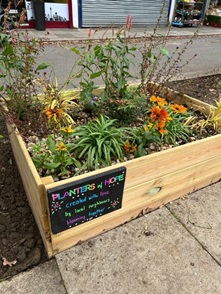
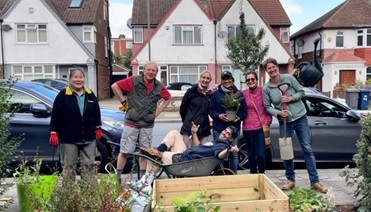
A big thank you to everyone who helped with the building of the wooden planters in Pennine Parade and at the Purbeck Drive park entrance last year. We moved mountains of soil and gravel on the day and planted evergreens, pollinator-friendly perennials and spring bulbs to brighten up the neighbourhood. Feel free to water the plants when you are passing by! The “Planters of Hope” project is a collaboration between Our Yard at Clitterhouse and GGERA, funded by the BXT Community Fund.

What’s coming up?

Help us to fight food waste and join our new Community Composting Project! A big thank you to the North London Waste Authority for funding this exciting project.

If you would like to get involved, please contact Anika at garden@clitterhouse.com.

Scouts

Do you know someone aged 13½ to 18 who wants to meet new people and try out a range of exciting activities?

Explorer scouts meet at Carey Hall, Claremont Road every Friday from 7:30 – 9:00 pm.

For more information, please contact Sarah on 07565 823 164.

Ban Plastic Grass Sports Pitches

Please sign this petition: https://www.change.org/p/ban-uk-local-authorities-from-constructing-artificial-grass-sports-pitches-on-greenspace. It will only take a couple of minutes.

The pitches cause significant microplastic and chemical pollution in the environment. The decontamination of these green sites would be extraordinarily expensive. The petition asks the Environment Agency to ban local authorities from constructing any more pitches in parks and green spaces because they harm wildlife and people. It is also unsustainable development.

  1. Rubber crumb pitch infill is made from used tyres and contains hundreds of toxic chemicals.
  2. The rubber crumb particles are microplastics that escape easily into the environment and pollute soil, water, air, wildlife and people. Animals eat the microplastics mistaking the crumbs for food. Players accidentally ingest or inhale the particles. They can also be absorbed through the skin.
  3. Rubber crumb contains hundreds of chemicals including carcinogens, endocrine disrupters, reproductive and developmental hazards. For example: Lead, phthalates and polycyclic aromatic hydrocarbons (PAHs).
  4. PFAS forever chemicals have been found in the plastic grass blades and backing. PFAS chemicals accumulate in wildlife and humans. PFAS pollution is fuelling the biodiversity crisis. Exposure to the most studied PFAS is linked to an array of adverse health effects including thyroid disease, liver damage and an increased risk of breast, kidney and testicular cancer.
  5. The pitches create wildlife deserts, destroying soil biodiversity, habitat and foraging sites.
  6. The pitches are barriers to animal movement, fragmenting landscapes and harming ecological connectivity.
  7. The pitches cause urban heat islands, reducing the quality of the air and release harmful chemical gases in hot weather.
  8. Floodlit pitches cause light pollution that affects bats, insects, birds, other animals, trees and people.
  9. The pitches increase the risk of serious flooding problems.
  10. There are no facilities in the UK to recycle pitches

Spring at Last!

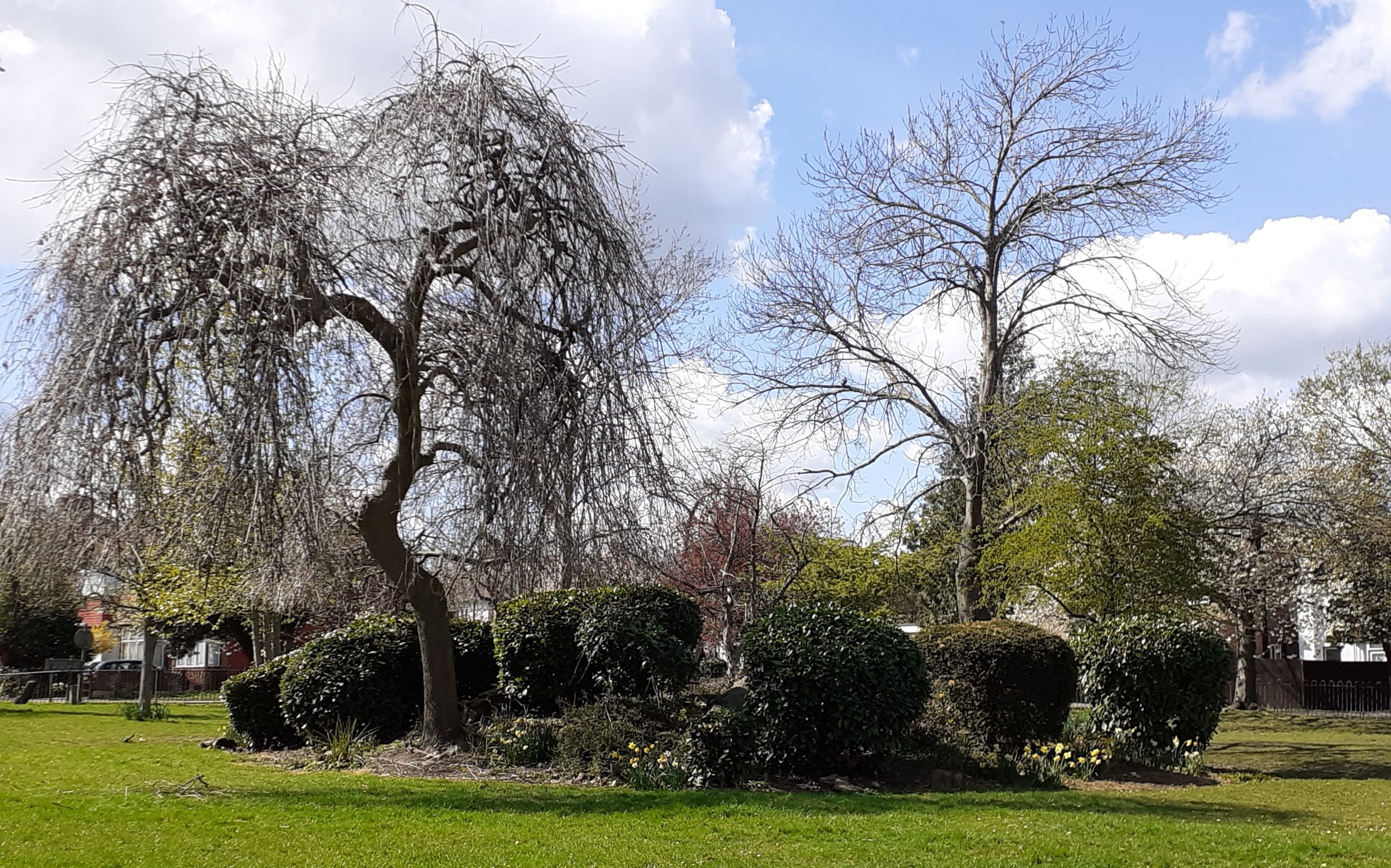
It’s lovely to see that Spring has finally arrived – even if it is still a little chilly.

If you have ideas to improve our neighbourhood or would like to suggest something to include in a future newsletter, do let us know.

The Golders Green Estate is a 1930s John Laing Estate built on the former Cricklewood Aerodrome. It consists of 1,000 semi-detached properties.

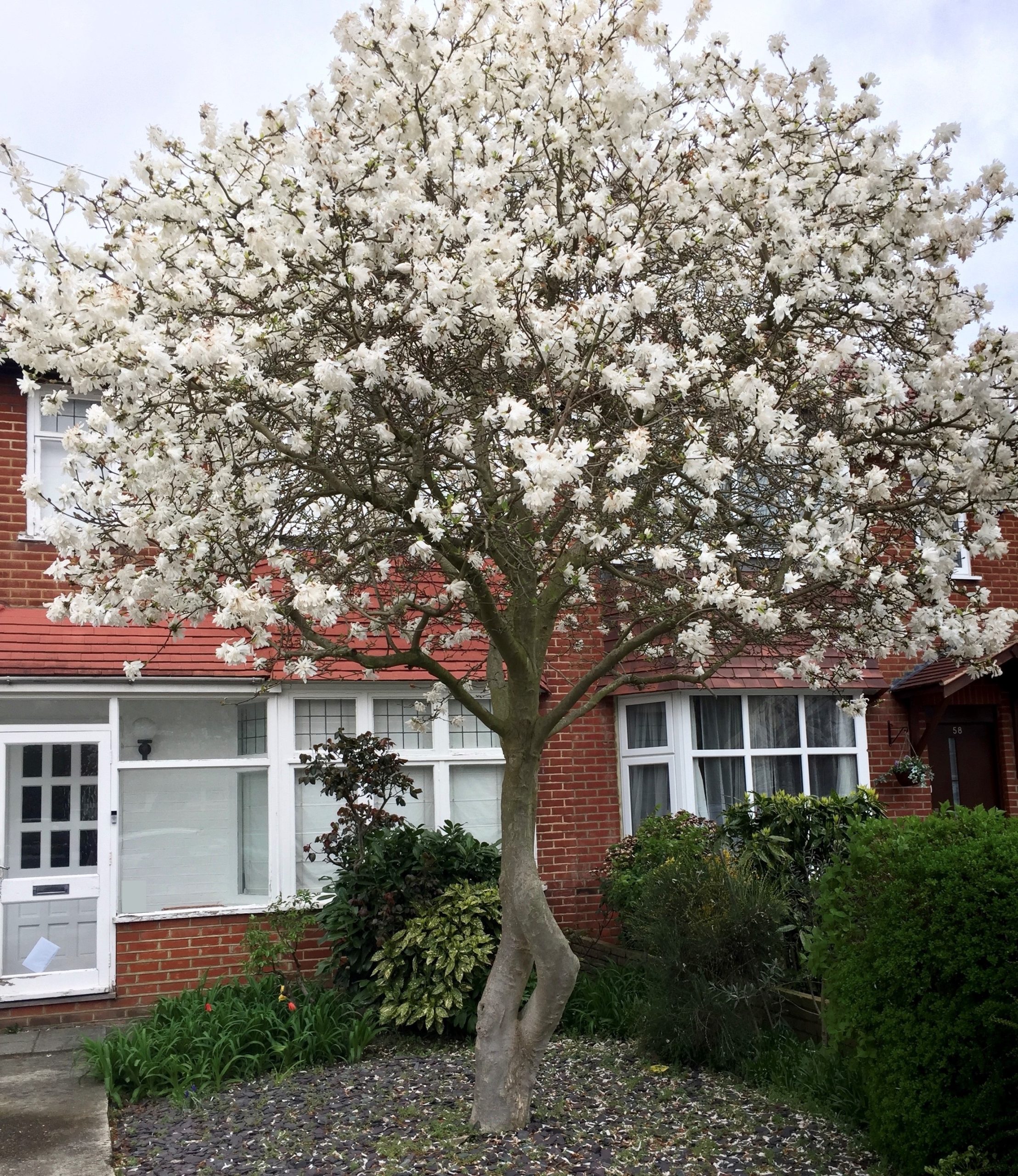
The late Mary Bennett, who moved here in the early days of our neighbourhood, used to say that every front garden had a tree, either a flower or a fruit tree. It must have been a magnificent sight!